Repetitive Strain Injury Explained. Also known as Overuse Syndrome or Work Induced Upper Limb Disorders
What is Repetitive Strain Injury, RSI? This is an increasingly common condition that affects many people. These terms above cover a variety of overuse injuries to muscles, tendons and nerves, predominantly of the forearm, wrists and fingers. Some of the conditions considered to be overuse syndromes, are bursitis, carpal tunnel syndrome, rotator cuff syndrome, tendinitis and tenosynovitis.
Who tends to get RSI? People who use machines that vibrate constantly, play a racket sport, use a keyboard and mouse, or play a musical instrument. Such activities require repetitive movements of the fingers and wrists, often at speed, for hours on end. However, one pupil told me that her tendinitis came after spending a whole day weeding her new garden! This had involved her twisting and pulling on the weeds in a repetitive way for hours on end.
A report on the BBC news quoted Professor Peter Buckle, University of Southampton, as stating that his research (2007) had shown that ‘In some populations that we’ve studied, between 22% and 40% of people have evidence of RSI’. These figures are rising, with approximately 115,000 people in the UK having some form of RSI, which costs the economy 300m per year.
Symptoms of RSI
The symptoms of Repetitive Strain injury are pain, weakness and tingling in the muscles and joints of the fingers, wrists and forearms. These symptoms tend to worsen over time if the condition is not addressed and treated. Initially the discomfort may only be experienced for short periods, during the activity that initiated the condition. This is the point at which changes need to be made in your habitual manner of body Use and probably in your conditions of work, so that some of the damage can be healed and the condition halted before it gets worse.
If someone with RSI ignores the early warning signals and continues to end gain, working or practising in the same habitual way, the pain can gradually become continuous, chronic and disabling. At this point, it may be extremely hard to heal the condition.
Prevention is better – and easier – than cure.
Unfortunately, many people do go on working without addressing the problems they are experiencing. BAPAM (the British Association for Performing Arts Medicine) is familiar with this problem in musicians, who are sometimes afraid to ask for help in the early stages of RSI, in case they are seen as unfit to play and thus lose work. However this unwise decision often leads to severe problems developing and by the time performers eventually seek help, they find they have to stop playing, sometimes for months and occasionally completely.
As Elizabeth Langford so clearly puts it in her informative chapter which discusses how the Alexander Technique can help people with Repetitive Strain Injury ‘You… need to become receptive to warning signals before they become pain, before they become strain, before they become injury’
Elizabeth Langford ~ Mind and Muscle p.209
Causes of RSI
The causes of RSI are many and often interact to contribute to the condition. The most significant of these is perhaps the least recognized by the medical establishment: the manner in which we misuse ourselves, so that we create movement habits and poor posture that interfere with our functioning and strain our musculoskeletal system.
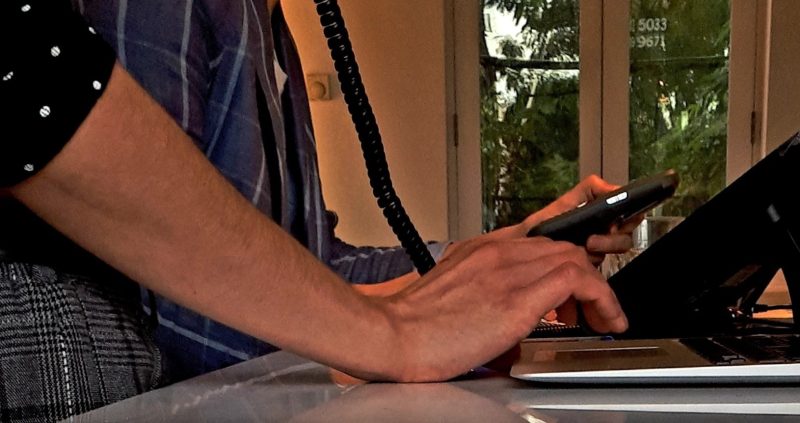
Wrist compression may contribute to Repetitive Strain Injury, RSI
Sit-stand desks may help some conditions but it is always important to be aware of how you are using yourself while you work. This young woman was standing, but constantly had her wrist contracted whilst typing. This misuse is likely to irritate her median nerve and may well develop into RSI if she continues with this habit.
An example of misuse and overuse, is a young man came to me for Alexander lessons, who had constant pain in the left shoulder. This had developed as a result of teaching himself to play the double bass, without having any lessons from a teacher, or thinking about his body use whilst playing. He was twisting around and lifting his left shoulder, in order to reach over the instrument to the strings. His wrists were over extended and his hands were very tense. He had been over-practising and repeating phrases for hours on end, whilst using this tense and distorted position.
He had been learning the instrument for just one month and this sudden increase and over-use of his muscles was bringing about the shoulder pai . Without a change in his use and playing technique, it is likely that he would soon be unable to play because of pain in his hands as well as his shoulders.
So some of the causes of RSI are:
- Overuse and misuse of the same set of muscles whilst performing the same activity over and again, so that they become fixed and tense and the circulation becomes sluggish. Sometimes this can be linked to feeling ‘bored stiff’.
- An end gaining, driven attitude towards work, which usually goes hand-in-hand with an intense manner of performance and overuse. This tends to go with a reluctance to take short breaks during the working day, let alone holidays. These habits will tend to escalate with high stress levels, so the person’s mind and body cannot unwind and free-up without help.
- Poorly designed or badly placed equipment, or a musical instrument that is held in a way that hampers movement, can contribute to the condition.
- Even with good ergonomically designed equipment, many people still have poor posture and general misuse which contracts muscles and reduces the capacity of the body to function properly. These muscle tensions can irritate the nerves and build up to RSI.
- Over-long working hours and a too-heavy schedule put too many extra demands on people, so that they become exhausted and far less able to take care of their use whilst working and performing.
- Cold temperatures can contribute to the condition – for instance, working whilst sitting under the cold draft from an air conditioning unit.
- High stress levels can result in extra tension and ‘feeling down’ which can interfere with our poise, restrict our movements, create mis-use and sometimes lead to RSI.
In her book ‘Save Your Hands!’ Lauriann Greene describes how she had to give up her career as a massage therapist, because her training had left her with painful RSI. Greene also saw that other therapists had similar problems. This had come about largely because of institutional end gaining, with tutors omitting to consider the means whereby trainees were working.
Greene states that ‘As I read texts on massage, it struck me that the emphasis was always on ensuring the comfort and safety of the client, not the practitioner’ p 4. Greene sees that an important part of helping other massage therapists to avoid such an outcome is to encourage them to work on their body alignment and to notice what is going on in their own body whilst they work, saying ‘Movement centered disciplines like… Alexander Technique teach students how to move their body in less stressful ways to encourage overall health’ and ‘ can be extremely helpful for massage therapists’
Lauriann Greene ~ Save Your Hands! p 105.
Treatment
It is important to see your GP about conditions such as RSI. Medical treatment for Repetitive Strain Injury includes rest, anti-inflammatory medication, pain killers, steroid injections, physiotherapy and the wearing of a splint. All of these treat the symptoms and aim to rest the injury – but do little to address the habits of misuse which usually causes the problem.
The RSI Awareness Association, RSIA, states ‘The effectiveness of the Alexander Technique is well documented and has been the subject of several scientific studies. It is increasingly recommended by doctors, and many medical insurance companies will pay for lessons if these are prescribed by a consultant’.
It is important to remember that no amount of pain killers will actually change the condition for you. Your work situation needs to be altered and you need to learn how to let go of your habits, behaviours and thought patterns that helped cause the condition. Then a new way of working may be learnt which puts less strain on your body. As can be seen from the testimonial at the end of this article, the use of the Alexander Technique can transform the way a person approaches their work, so that conditions such as RSI can be greatly alleviated.
Some simple self-help tips
A few simple things that you can begin to do which can begin to help RSI, particularly if you are using a computer, are listed here:
- Make sure that furniture, equipment and instruments are well placed and suitable for your body size and movements. Place your monitor at eye height. Sit or stand with an easy, balanced posture. It can be really helpful to use voice-activated software until you learn how to change the way you compute and work. Perhaps find yourself some different furniture. Vary the type of mouse you use, so that you use different sets of muscles.
- When using a keyboard, use your arms in as relaxed and easy a manner as you are able, with your elbows at a 900 angle. Let your feet rest comfortably on the floor, with your knees also at a 900 angle. If necessary use a footrest.
- Take regular short breaks and vary the tasks and range of movements made, to help re-balance muscle usage. Make use of software that monitors your computer use and indicates when it is a good idea to stop for a while. Use your break to move around, let go of tensions and free-up your muscles.
- Most important is to pay particular attention to your body Use and the means-whereby tasks are performed. This is most easily done with the help of an Alexander Teacher. Make sure you are poised, your movements are free and that you resist any urge to being driven, contracted and tense whilst working.
- Take regular exercise such as walking, which will help your general muscle tone and circulation, particularly if you pay attention to the manner in which you walk, so that you avoid creating different patterns of tension and allow your body to work freely as you move. (A workout at the gym may make matters worse if you push yourself too hard and end gain)
- Avoid sitting in draughts and keep warm enough.
Try taking a course of Alexander Technique lessons. Someone with RSI who is willing to allow themselves to change their way of working can learn how to manage their condition, let go of entrenched habits of misuse, reduce and sometimes even eliminate pain in the process. Maybe you could do this too? I have taught several people who have done just that and importantly, they are also able to use the Technique to help prevent the condition from recurring.
A pupil’s experience of how his Alexander lessons, alongside medical intervention, enabled him to play music again:
” When I first visited Hilary I was in constant pain and could not even hold a cup of tea, let alone play the guitar. None of the medical professionals I visited had offered me a diagnosis, much less a cure. After my first session the pain was greatly relieved and six months later I’m playing the guitar again, albeit very carefully. I was first introduced to the Alexander Technique at music college and, to be honest, was rather sceptical about it. I now realise that, using it’s techniques, I could well have avoided the RSI which has prevented me from working for almost 6 months.
My lessons with Hilary have transformed the way I approach both my music and my health. Apart from enabling me to play again, it has actually improved my instrumental technique and enhanced my enjoyment of music. The Alexander Technique is a very logical, practical tool which enables one to spot potential physical problems and find solutions which can be easily incorporated into a daily routine. I would recommend both Hilary King and the Alexander Technique to anyone, but especially musicians, including those who are seemingly healthy. Quite simply, it will make you a better musician and a healthier human.”
Andy Hopkins ~ Composer and Guitarist
You may read the full testimonial here. Andy is now able to work full time as a composer for TV and film, using computers and many musical instruments plus coping with frequent deadlines and ‘rush jobs’.