Archives


Subscribe Subscribe [What is this?]

Hilary King's Blog

Read more about the Alexander Technique including observations on more general topics that interest me, and notifications about my teaching timetable.

Switch Off to show you care about Climate Change
27 March 8.30pm

Challenge your habits and turn off all electrics that are not essential for one hour. No lights, no TV, no music, no computer.... Have fun and create a different sort of evening for yourself, along with hundreds of people around the world that are joining this WWF campaign. Draw attention to the issues involved with adapting to climate change and think about what life may be like without our familiar appliances available to us if there are power shortages in the future.

So why am I mentioning this here on my Alexander Technique Blog?

I aim to run my Alexander Technique teaching practise in an environmentally aware way and work towards being as energy efficient as I can, so this falls naturally into my field of awareness.

Also, in Alexander lessons, we are always learning how to let go of habits that don't serve us and in many ways we all need to do exactly this - let go of many of our habits - in order to reduce our carbon footprints and energy consumption. How often do we leave the tap running, the lights on, or the the TV constantly on, just by habit, even though we are not even using them? What a waste of these valuable resources!

We can inhibit, stop these habits and make simple but important changes in our lives that will help conserve  our fragile environment.

As the WWF says - Be Bright, Turn Off the Light!

Further info about WWF Earth Hour:

http://earthhour.wwf.org.uk/about_earth_hour/

RSI Conference 2010

RSI Action - The Repetitive Strain Injury Charity will be holding its Annual Conference in the Friends' Meeting House on Euston Road on 20 March.

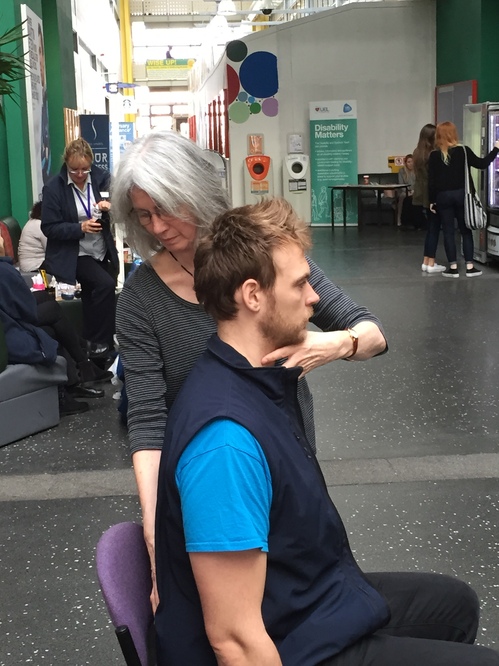
The Society of Teachers of the Alexander Technique, STAT, will have a stall at the conference. Mini-sessions will be available, so that people can begin to get a sense of how the Alexander Technique can help them change the way they 'Use' themselves so that they can begin to reduce and control RSI.

I shall be there on the STAT stall in the afternoon, after the end of my morning's Introductory Alexander Technique Workshop in aid of the UNICEF Haiti Earthquake Appeal as below.


If you would like to read more about the application of the Technique in relation to RSI, there is an article on my Website here.

Date:    20 March

Venue: Large Friends Meeting House, 173 Euston Road, NW1

Time:   9.15am  - 4.45 pm


Introductory Alexander Technique Workshop for Women ~ 7 March.

My next Introductory Alexander Technique Workshop will be for women only and will be linked to International Women's Day. This is a chance for women who may feel uncomfortable working in a mixed group, to find out about the Alexander Technique

  • Experiential Games
  • Demonstrations and Discussion
  • Refreshments
This IWD Workshop includes an individual follow-up lesson in the fee.

SMALL GROUP max 6 - so it is essential that you book in advance to reserve a place.

Please Contact Hilary to see if there are still places available.

Further Information and Application Form Here

Alexander Technique Workshop

In aid of UNICEF Children's Emergency Appeal f
or victims of the Haiti and Chile Earthquakes

£25 Minimum
Fee / Donation
All the workshop fees will be donated to UNICEF and will be added to by Gift Aid

Saturday 20th March ~10.00am - 12.30pm

This workshop is for a small group of beginners, maximum six participants, so it is essential to pay in advance to reserve a place

Further Information here

Half Price follow-up lesson available to participants

My next AT Workshop is for Women only on 7 March
Poise and Posture

When we are children, most people have a beautiful easy poise, as is illustrated in this photo of a little girl sitting on a giant snow seat. Despite the obvious cold, the child is sitting easily and in a relaxed manner, whilst many adults would be bent over and tensed up against the chill!

There are many influences in our lives that get us interfering with our natural poise. Our attitudes and emotional experiences are reflected in the way we use our bodies and our minds gradually tend to become rather set so that our view of the world - and our physical responses to it - become rather fixed and habitual. Stress, peer group pressures, accidents and illnesses all play their part in moulding our habitual body use and many of us end up crumpling our bodies down into ourselves - whilst others over-extend and arch their backs in an attempt to 'stand up straight' - both of which pull us off our balance and poise.

Fortunately, F M Alexander realised that we are able to reduce some of these effects if we are willing to let go of habits of thought and behaviour that interfere with our natural use. During Alexander Technique lessons, we can learn how to do this and in so doing, regain much of the fluid, free and poised way of being and moving that we had as children and feeling more comfortable in ourselves.

You may read more about Alexander Technique classes here.


Child sitting in snow 07-01-2010 .jpg
Introductory Alexander Technique Course starts Monday 11 January - 1.0pm - 2.30pm.

Please note that the upcoming Introductory Alexander Technique Course will now be running for 4 sessions on Monday lunchtimes, rather than 5.

The fee for the course is now £65.

This course is for a small group of beginners. Please contact Hilary to see if it is still possible to book a place on the course. You may also phone her re the course or to book an individual lesson.
 
Tel: 020 7254 9206


New Research Paper

A new paper has been published in the OUP Family Practice (23 December 2009) which reports the findings of research into patients' views and attitudes towards learning the Alexander Technique, as part of the ATEAM Trial into treatments for chronic back pain.

This research looked at the psychological aspects underlying the ATEAM Trial and the outcomes showed that patients found the Alexander Technique was 'effective' and 'made sense' as it could be used during everyday activities, it had a 'convincing rationale' and that teachers provided good support and personal advice. The Alexander Technique was generally seen to be more acceptable to patients than the exercise regime which was prescribed by the doctors.The Technique was also seen as improving the patients' quality of life, which is great!

As one of the teachers selected to teach on the ATEAM Research Trial, I welcome this publication and the findings it reports, which tally with my experience of teaching the Technique to pupils from a wide range of backgrounds who predominantly find the Technique effective, not just for back pain but for helping and preventing the development of many conditions.

Alexander Technique Courses and Classes

If you would like to find out more about the Alexander Technique, you might like to join my upcoming
Introductory Alexander Technique Course, or you might prefer to dive straight in and try some individual lessons which are available on an ongoing basis.
With Every Good Wish for the Holiday Season

Take care on the icy paths, walk freely and easily - and have a wonderful holiday!

Alexander Technique lessons will resume on 5th January.

An Introductory Alexander Technique Course starts on 11th January - more info here.

Snowman & Terrace m  1 .jpg
The Richard Price Annual Memorial Lecture ~ Unitarian Church, Newington Green N16

Frankenstein's Bodies Today

The annual lecture will be given by the influential author and psychoanalyst Professor Susie Orbach. The title of the lecture links Orbach's sphere of work, the Unitarian Church and one of the famous members of its congregation, Mary Wollstonecraft - author, early feminist and mother of Mary Shelley, the author of 'Frankenstein'.

Susie Orbach co-founded the Women's Therapy Centre in North London and has written a number of books exploring issues such as gender, women's psychology and eating difficulties. Orbach is well known for her first book, 'Fat is a Feminist Issue' (1978) and her latest book is 'Bodies' (2009).

If you are interested in the Alexander Technique you are probably interested in your own body and you may find it revealing and informative to learn more about our society's attitudes towards our bodies. Susie Orbach's lecture promises to be a fascinating evening and well worth attending.

Date: 27 January 2010


Venue: Unitarian Church, Newington Green N16


Further info and tickets:

http://www.new-unity.org/events/events-calendar


Use the Alexander Technique While You Walk

When we have lots of rain and in particular when leaves or ice are on the ground, paths can become treacherous, as my own path gets at this time of year. It is very tempting to tighten up our legs muscles, ankles, the muscles around our hip joints and probably our neck muscles as well. Most of that tightening is done in anticipation of a possible fall and this can be tiring - and is rather a waste of energy! If we feel ourselves slipping, then bracing ourselves at that point can sometimes be helpful but we don't need to brace for long periods of time 'in case'.

This doesn't serve us. In fact, tightening our neck muscles reduces the information we can obtain about our balance, and locking our ankles and hips also interferes with our ability to fine tune our balance. I often look at young women wearing stilettos and wonder just how they manage to cope on slippery paths, because they are already thrown off balance because their hips knees, ankles and backs are pushed into unnatural positions by their high heels.

It is always helpful to think about the way we walk but it is particularly important when paths are slippery. You can help yourself by walking along with awareness and your neck freely lengthening, as you have learned in your Alexander Technique lessons, so that you obtain maximum information about your balance from the tiny movements your head will make as you move.  When you also allow your feet and legs to move and support you freely, without excessive bracing, you will probably feel far more comfortable and secure.

Home | Introduction | Alexander Lessons | Alexander Workshops | Glossary | Testimonials | Contact Me
Reading Lists | Shop
Hilary King - BA (Hons) PGDip Psychol. Dip Couns. MSTAT - Tel: 020 7254 9206
Copyright © 2004 - 2007 Hilary King, All rights reserved.