Archives


Recently in Alexander Technique Category

'Skeletons - London's Buried Bones'

If you are interested in how your body works plus how your posture, the way you use yourself and live your life, can leave it's mark on the structure of your bones, you may want to visit the              'Skeletons: London's Buried Bones' Exhibition that has just opened at the Wellcome Collection.

The skeletons on display are from the Museum of London's collection of 17,000 skeletons that have come from people who lived and worked in the London area over the last 16 centuries.

This exhibition looks at the events and health hazards of the day, that affected people's lives and their skeletons. There will also be a day of activities for all ages and a public debate about why the dead are useful to study.

Perhaps seeing the wear and tear on all those bones, may encourage us to be more aware of our own body use, right now, so that we change some of our unhelpful and even damaging habits and learn to do as much as possible to look after our own skeletons!
 
Venue: Wellcome Collection, 183 Euston Road

Date:   23 July - 28 September

Info:     www.wellcomecollection.org/events
  

Holiday Dates

| | Comments (0) | TrackBacks (0)
Here are some dates for your diary.

Please note that I will be not be teaching in Stoke Newington from

11th - 16th August

&

22nd August - 8th September

I will be available for lessons between these dates, from 18th - 21st August


My next Introductory Alexander Technique Course will commence on Saturday 13th September


This Course is for people who have little or no experience of the Alexander Technique and runs over 3 Saturday mornings:

13th; 20th; 27th September.

Participants will be able to have a half price individual follow-up lesson. This format allows you to gain a sense of what Alexander Technique lessons are like and be more able to decide whether or not you would like to continue with further lessons.

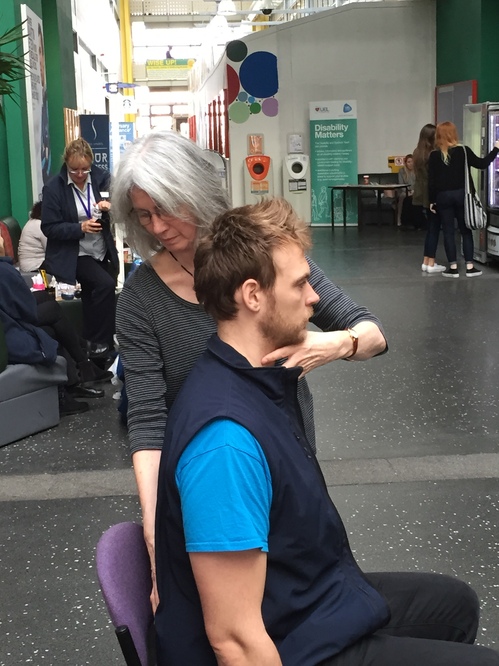
This Small Group Course, with a maximum of 6 participants, offers beginners the chance to find out about the Alexander Technique in a friendly environment in which you can experience some individual hands-on work with Hilary King, an experienced teacher.
STAT has just announced the launch of the STAT YouTube Channel. 

This interesting new resource is designed to let people find out more about the Alexander Technique in an easily accessible manner. So far, 28 film clips have been posted, which illustrate different teaching styles and approaches to the Technique. These have been produced and edited by David Reed, MSTAT.

You can even see an extract from a film of F M Alexander himself as he taught Margaret Goldie, who in her turn taught the Alexander Technique for over 60 years. There are also films showing some 'first generation' and senior Alexander Teachers, who demonstrate aspects of the Technique plus their own styles of teaching and running workshops.

It is hoped that there will be an increasing number of videos on the site, from a wide variety of sources and STAT would welcome films that show A/T teachers in action.

This is a great way to extend your understanding of the Alexander Technique and it brings the work into a lively focus. Try it!

http://uk.youtube.com/user/TheSTATChannel


Dates for your Diary

Please note that I will not be teaching the Alexander Technique in Stoke Newington from 9th - 16th August, as I will be attending the 8th International Congress of the F M Alexander Technique in Lugano, Switzerland.

This should be an enriching experience, as the Congress offers all teachers of the Alexander Technique a chance to exchange work and ideas with other Alexander teachers from around the world. We may have different styles of teaching but we have all developed our work within the framework of   F M Alexander's theories and teaching practice.
STAT was formed in 1958 by a group of Alexander Technique teachers, all of whom had been trained by F M Alexander himself. It is the oldest and largest professional organisation devoted to the Alexander Technique. Currently, there are over 2,500 teaching members within STAT and its Affiliated Societies worldwide.

The Alexander Technique itself has been taught for over 100 years and STAT aims to ensure that a high level of Teacher Training and teaching practice are maintained throughout the profession.

STAT is the professional body to which I belong and all teaching members have trained at a STAT recognised 3 year Training Course. We are also required to adhere to the Society's published Code of Professional Conduct and Competence, and to be covered by professional indemnity insurance.

STAT held the AGM at the Hellenic Centre on 21st June '08.

The Annual Memorial Lecture, 'The First Step',  was given by Anne Battye, followed by a celebratory champagne reception for members of STAT.
Ellen Graubart a local artist who, incidentally, is familiar with the Alexander Technique, held a solo exhibition which was well worth going to see. You can read about Graubart and see some of her work if you visit the URL below. I'll let the photos of the paintings speak for themselves but will add that they are even better in reality. It was an exciting and vibrant exhibition.

Thumbnail image for Sailing 2. Ellen Graubart JPG Art exhibitions are a time when many people end up with back ache, because they are standing for long periods without being aware of the way they are using their bodies. Looking up above eye level to see a painting, without awareness, can contribute to the problem if we contract our neck and the muscles in our lower back. This can create problems such as a hollow back, putting pressure onto the lumbar vertebrae and discs, which causes discomfort and even back pain.

So take yourself to art exhibitions and remember all you have learned in Alexander lessons; be aware of your use, look after your neck and back so that you remain freely poised and pain-free.


Sailing 2 - Ellen Graubart


http://www.millineryworks.co.uk/

The Henry Moore exhibition at Kew Gardens finished at the end of March but leaves a wonderful memory for all those who saw it.

 Thumbnail image for Thumbnail image for Henry Moore 8 Kew March '08.jpg
Mother and Child, although very abstract, evokes a strong sense of calm tenderness. Mother is portrayed holding the baby in a way that allows a safe, intimate connection with her.

I could also see the sculpture from an Alexander Technique perspective, as illustrating a common habit that many people have: contracting down on one side of the body and looking down with the head and neck to one side. Such patterns of mis-use can also be developed when writing, playing the guitar or using a mouse for instance.

If people habitually assume lop-sided positions, an imbalance in muscle use occurs, subjecting the vertebrae and intervertebral discs to an uneven, downward compression. This can cause back pain and problems such as scoliosis and sciatica.

So keep that tender intimacy with your child but remember to look after yourself at the same time. If a great work of art can also remind us to be aware of our own use, that is an unexpected bonus.


Henry Moore ~ Mother and Child ~ Kew Gardens

Do you enjoy running and would like to think more about your use whilst doing so? It is certainly possible to do this in your regular Alexander lessons, to great effect. Also, there are a couple of Workshops coming up in London with Malcolm Balk, author of Master the Art of Running, that will look in depth at how to improve your running technique.

The Workshops are designed to incorporate the Alexander Technique into your running, so that you can hone your skills, run more freely and avoid injury.

Dates: April 27th; May 4th

Contact: Brita ~ britafor@alextech.freeserve.co.uk


How aware are you, of the way you use yourself when telephoning? Watch other people using a phone, it can be an eye-opener. You may well see habits that you can recognise as being similar to your own, so that you can learn from them about your own use (and mis-use).

The most exaggerated way of mis-using yourself when phoning, is to clamp the phone between your ear and your shoulder whilst you continue another activity with your hands free.  With this habit, it is usually the same shoulder that always gets scrunched up. Just think about what happens to your neck, as you continually compress down on one side of the vertebrae. Neck and shoulder pains will soon be on their way, if they are not with you yet, unless you stop this habit.

Another common form of mis-use, often seen in busy open plan offices and noisy public places, is to thrust the neck forwards, curling in and downwards whilst talking, in an attempt to gain some sense of privacy. This is a particularly frequent form of mis-use seen in mobile phone users. This cannot create the private space we would like but it does create tension and problems in the neck, shoulder and upper torso. These become very tight, stiff and pulled down into a forward curve as we box ourselves in, often resulting in back and shoulder pain as a result of developing a pronounced kyphosis.
 
Our sensory appreciation is often faulty, so we can be unaware of such habits of mis-use, even when we are conscientious about applying the Alexander Technique in other areas of our life.
 
One young woman realised that this habit was so strong that it felt impossible for her to use her left hand and ear during a phone call, even though her hearing functioned perfectly well in both ears. Now that's a strong habit that was purely built around her perceptions. However, once aware of her pattern, the young woman could begin to let go of it and work to improve her use, both during Alexander lessons and during her phone calls.

This sort of habit is a good example of how our thoughts and attitudes get played out in our bodies, illustrating the way the body and mind interact and work as one.

If you would like to recycle your old mobiles, I can send them to various charities, including BackCare 'the charity for healthier backs' with whom I am registered as an Affiliated Professional Member.


Home | Introduction | Alexander Lessons | Alexander Workshops | Glossary | Testimonials | Contact Me
Reading Lists | Shop
Hilary King - BA (Hons) PGDip Psychol. Dip Couns. MSTAT - Tel: 020 7254 9206
Copyright © 2004 - 2007 Hilary King, All rights reserved.